
📑 Table of Contents
- Introduction
- The Evolution: From Keys to Biometrics
- How Digital Locks Work
- Advantages Beyond Convenience
- Challenges and Solutions
- Choosing the Right System
- Real-World Success Stories
- The Future of Digital Locks
- Installation & Maintenance
- Cost-Benefit Analysis
- Conclusion
🏠 Introduction: The Lock Revolution Has Begun
The traditional lock and key has been humanity’s trusted security companion for centuries. Yet in the span of just a few years, this ancient mechanism is undergoing a seismic shift. Today, millions of Indian homeowners are abandoning their key rings in favor of fingerprints, facial recognition, and smartphone apps. The question is no longer “Should I upgrade to a digital lock?” but rather “Why haven’t I already?”
The digital lock market in India is experiencing unprecedented growth. Industry data shows that India’s smart lock market is on track for double-digit annual growth through 2034, driven by rapid urbanization, increasing security concerns, and the widespread adoption of IoT devices across the country. With India’s metro cities accounting for 14.65% of all cognizable offenses despite housing only 8.12% of the population, the urgency for advanced security solutions has never been more pressing.
This comprehensive guide explores how digital locks are revolutionizing home security, why they represent the future of access control, and how you can make an informed decision when choosing a system for your property.
📚 The Evolution: From Keys to Biometrics
A Brief History of Lock Technology
Locks have evolved dramatically over time. The mechanical pin tumbler lock, invented in the 1800s, represented a revolutionary leap forward in security. For over 150 years, this technology remained largely unchanged. A thief determined enough could pick, bump, or force a traditional lock—and many did.
According to crime statistics, India recorded over 5.8 million cognizable crimes in 2023, with burglary and theft constituting significant portions of these offenses.
The advent of the digital age introduced electronic locks in the 1970s and 80s, primarily in high-security government and corporate facilities. However, these early systems were bulky, expensive, and prone to technical failures. It wasn’t until the last decade that digital locks became truly practical, affordable, and reliable for everyday home use.
Why 2025 Marks a Turning Point
Three fundamental shifts are making digital locks the preferred choice for Indian homeowners right now:
1. Market Expansion and Affordability
The smart lock market has matured significantly. Competition among manufacturers has driven prices down substantially, making these systems accessible to middle-class Indian families. What cost ₹50,000+ just five years ago is now available for ₹8,000-15,000. Simultaneously, better availability through online platforms like Amazon and Flipkart means consumers aren’t limited to specialty stores.
2. Multi-Method Authentication
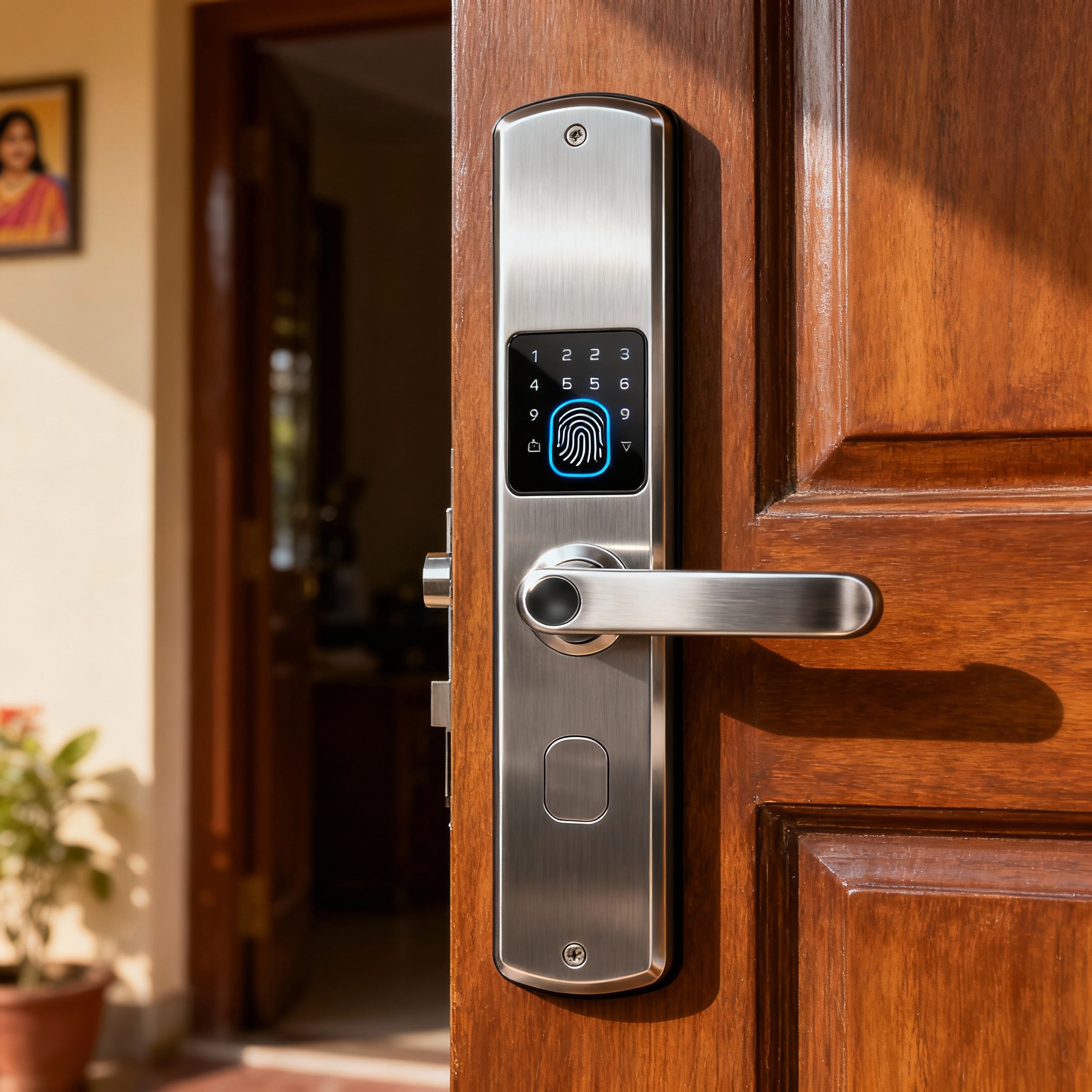
Modern digital locks don’t rely on a single authentication method—they embrace redundancy for security and convenience. A contemporary smart lock typically supports fingerprint scanning, PIN code entry, mobile app access, guest OTP codes, mechanical key backup, and RFID card readers.
3. Seamless Ecosystem Integration
Digital locks are no longer standalone devices. They integrate into broader smart home ecosystems. In apartment communities, platforms like Mygate have become the central hub. For individual homeowners, integration with Alexa, Google Home, and Apple HomeKit creates a unified control center.
⚙️ How Digital Locks Work: The Technology Behind the Security
Core Components
Every digital lock system comprises several key elements:
| Component | Function | Key Features |
|---|---|---|
| Lock Mechanism | Physical deadbolt | Solenoid or motor-driven; 500,000+ operation cycles |
| Biometric Sensor | Fingerprint reading | Capacitive/optical; 100+ fingerprint storage; <1% false rejection |
| Control Board | Intelligence processor | Authentication management; 128-bit encryption minimum |
| Power System | Energy source | Lithium-ion battery; 6-12 months per charge; USB charging |
| Communication | Data transfer | WiFi/Bluetooth; Cloud integration; Mobile app support |
The Authentication Process
When you approach a digital lock, the process is remarkably swift:
- You place your finger on the scanner
- The biometric sensor captures your fingerprint data
- The control board compares it against stored templates
- If there’s a match, the system logs the access attempt (user, time, method)
- The solenoid energizes, retracting the deadbolt
- You turn the handle and enter
- The lock automatically re-engages
The entire process takes 0.5-2 seconds. For PIN entry, it’s similarly quick. For mobile app access, the speed depends on your WiFi/Bluetooth connection but typically completes in 1-3 seconds.
✨ The Advantages of Digital Locks: Beyond Mere Convenience
1. Enhanced Security and Crime Deterrence
A visible digital lock acts as a powerful psychological deterrent. Studies of smart home security adoption show that the presence of smart security devices reduces reported theft attempts and burglaries. Why? Because criminals typically seek easy targets.
Security Benefits:
- Zero Forced Entry: Cannot be picked or bumped like mechanical locks
- Comprehensive Access Logs: Every entry timestamped and recorded
- Temporary Access: Grant time-limited access without changing locks
- Remote Revocation: Instantly disable access from anywhere
2. Practical Convenience for Daily Life
Consider this typical scenario: You arrive home carrying groceries. Your phone is in your pocket, your hands are full. With a traditional lock, you’d struggle to retrieve your keys. With a digital lock using fingerprint recognition, you simply press your thumb to the scanner while your hands remain free. The door opens effortlessly.
3. Solving the Lost Key Problem
Approximately 15-20% of emergency locksmith calls stem from lost keys. With a digital lock, lost keys become irrelevant. Even if someone steals a backup mechanical key, you can immediately disable their access through the system’s app.
4. Integration with IoT Ecosystems
Modern digital locks communicate with smart lights, alarms, CCTV systems, and video door phones. This ecosystem integration creates comprehensive security and convenience systems.
5. Accessibility for Individuals with Physical Limitations
Traditional locks present challenges for people with arthritis, weak grip strength, or limited dexterity. Digital locks eliminate these problems through biometric access and mobile app controls.
⚠️ The Challenges and How to Address Them
Challenge 1: Battery Dependency
Solution: Quality digital locks include low-battery alerts 4-6 weeks before depletion, extended battery life (6-12 months), mechanical key backup, and USB charging ports for rapid power restoration.
Challenge 2: Technical Failures
Solution: Multi-method authentication (fingerprint + PIN + app), mechanical key backup, 24/7 customer support, 2-3 year warranty coverage, and extremely rare failure rates with quality brands.
Challenge 3: Cybersecurity Concerns
Solution: Modern locks use 128+ bit encryption, two-factor authentication, regular firmware updates, offline operation capability, and physical tampering sensors.
Challenge 4: Biometric Limitations
Solution: Modern capacitive sensors have <1% false rejection rates, multiple fingerprints can be registered (50-100), backup authentication methods available, proper enrollment technique improves accuracy.
🔍 Choosing the Right Digital Lock for Your Home
Assessment Questions
Before purchasing, ask yourself:
- What is your budget? Entry-level: ₹5,000-8,000 | Mid-range: ₹8,000-15,000 | Premium: ₹15,000+
- Do you live in an apartment or independent house? Apartments benefit from ecosystem integration; houses prioritize individual control.
- How many household members need access? Consider expandability of biometric slots.
- Do you require mobile app access? Essential if you travel or have frequent visitors.
- What is your WiFi reliability? Consider redundancy with Bluetooth.
Top Considerations When Comparing Models
| Specification | Importance Level | Good Standard | Excellent Standard |
|---|---|---|---|
| Build Quality | Critical | Aluminum body | Stainless steel |
| Authentication Methods | Critical | 3 methods | 5+ methods |
| Response Time | Important | <2 seconds | <1 second |
| Battery Life | Important | 6 months | 8-12 months |
| Warranty | Important | 2 years | 3+ years |
| Customer Support | Important | Business hours | 24/7 support |
📖 Real-World Success Stories
Case Study 1: The Working Professional
Priya, a 32-year-old IT consultant in Bangalore, travels frequently for work. Before installing a digital lock, she worried constantly about housekeeping staff access. After installing a Godrej digital lock, Priya manages everything through an app. Her housekeeper has a time-limited PIN working only on Tuesdays between 9 AM and 2 PM. She receives notifications when the staff member enters and exits. “The system has transformed my peace of mind,” she reports.
Case Study 2: The Multigenerational Family
The Sharma family in New Delhi—grandmother, parents, and two children—live in a villa. The grandmother had weak gripping ability from arthritis, and children occasionally lost keys. With their Qubo digital lock, everyone uses their fingerprint. The grandmother can enter independently without pain. The children cannot lose their biometric.
🚀 The Future of Digital Locks: Where Technology is Heading
Facial Recognition Integration
Next-generation systems will add facial recognition to complement fingerprints. Imagine standing at your door; the system recognizes your face and automatically unlocks—no touching required.
AI-Powered Anomaly Detection
Advanced systems will use machine learning to detect unusual access patterns and alert you to potential security threats.
Blockchain-Based Access Management
For commercial properties, blockchain technology will enable immutable access logs that cannot be tampered with or forged.
Integration with Public Infrastructure
Smart city initiatives are integrating digital locks with urban infrastructure for emergency responder access during disasters.
🔧 Installation and Maintenance Guide
Professional Installation vs. DIY
Most digital locks come with installation options. While technically savvy individuals can install them, professional installation (₹2,500-4,000) ensures:
- Proper alignment ensuring smooth operation
- Correct wiring and battery connection
- Biometric enrollment with optimal placement
- Integration with your home automation system
Regular Maintenance
- Monthly: Test backup PIN and mechanical key
- Quarterly: Clean fingerprint scanner; update firmware
- Biannually: Professional servicing to check mechanisms
- Annually: Complete system audit
Troubleshooting Common Issues
| Issue | Solution |
|---|---|
| Lock won’t open | Check battery level; try mechanical key or temporary PIN |
| Fingerprint not recognized | Reposition your finger; re-enroll if issue persists |
| App connection issues | Restart router; check WiFi password; reinstall app |
| Slow operation | Clear app cache; check for firmware updates; clean scanner |
💰 Cost-Benefit Analysis: Is a Digital Lock Worth It?
Initial Investment
A quality digital lock system costs ₹8,000-20,000 installed. Compare this to:
- Traditional lock replacement: ₹500-2,000
- Emergency locksmith call: ₹3,000-5,000
- Key duplication costs over 10 years: ₹5,000-10,000
- Potential losses from theft: Significantly higher
Long-Term Benefits
- Reduced anxiety about security
- No emergency locksmith calls for lost keys
- Insurance premium reductions (10-15% for some providers)
- Permanent solution – no recurring key-related expenses
- Home value increase – smart home features enhance property resale
ROI Timeline
Most homeowners recover their investment within 5-7 years through avoided locksmith calls, insurance savings, and reduced security concerns.
✅ Conclusion: The Lock Revolution Has Begun
The shift from mechanical locks to digital locks represents more than just a technological upgrade—it’s a fundamental transformation in how we think about home security, access control, and personal convenience. With India’s smart lock market growing at double-digit rates and prices becoming increasingly affordable, digital locks are transitioning from luxury items to standard home security solutions.
The benefits are undeniable: enhanced security, unmatched convenience, comprehensive access management, and seamless smart home integration. While challenges exist—battery dependency, technical failures, cybersecurity concerns—they’re manageable with quality products and proper maintenance.
For Indian homeowners seeking to modernize their security, reduce daily friction, and join the smart home revolution, digital locks represent an investment in peace of mind. The question is no longer whether to upgrade, but which digital lock system aligns best with your specific needs and lifestyle.
The future of home security is digital. The question is: when will you unlock it?
Ready to Transform Your Home Security?
Explore our complete range of smart digital locks and security solutions.
Contact our experts to find the perfect digital lock system for your home.
📚 References & Sources
- India Smart Lock Market Growth Forecast – Custom Market Insights, 2025
- Smart Lock Pricing and Market Analysis – MyGate Blog, 2025
- Smart Home Ecosystem Integration – Mordor Intelligence, 2025
- Smart Home Security Market Adoption and Crime Deterrence – IMARC Group, 2024
- India Smart Lock Market CAGR Projections through 2034 – Market Research Reports, 2025
- India Crime Statistics – NCRB Data, 2023
- Bureau of Indian Standards (BIS) – Lock Certification Standards